The analytic point-source model, assumptions and throughput terms behind the ESC exposure-time calculator.
Calculation model
ExtraSolar Coronagraph
The ESC ETC is an analytic point-source model for planet detection. It combines planet, zodiacal, exozodiacal, detector, and residual-speckle terms at the selected separation.
S is the planet rate, Z/E are zodiacal/exozodiacal rates, D is total dark rate, Q is speckle photon noise, and M = Q / Gpp is the post-processed systematic speckle floor.
Model assumptions
Photometry: analytic point-source rates over one selectable extraction aperture (below); no 2-D detector image is simulated.
Coronagraph: the tabulated focal-plane-mask off-axis throughput at the nearest modeled separation is applied to the count rates.
Speckles: raw dark-hole contrast sets the speckle rate; post-processing gain reduces its systematic noise-floor term.
Background: zodiacal and exozodiacal surface brightnesses are scalar inputs, not sky-position, date, or target-system models.
Reachability: an exposure-time target can become unattainable when the requested SNR lies above the systematic speckle floor.
Outputs and provenance
Planet SNR and the contributing count rates, with bandpass, source-spectrum, and count-rate plots. The count-rate plot and table include the read-noise equivalent rate R²Npix/tframe, so read noise compares directly with the photon rates.
The extraction aperture drawn over a noiseless, pixel-integrated Airy PSF of the planet, with a cut through its central row.
The engine can also solve for the integration time that reaches a target SNR; this calculator does not expose that mode.
Extraction aperture
Every SNR term is evaluated in one photometric aperture centred on the planet. Its encircled energy EE is the fraction of the planet’s (and the speckles’) light credited to S and Q; its pixel count Npix is what dark current and read noise are charged over; its solid angle sets the zodiacal and exozodiacal rates. The fractions are those of an unaberrated Airy PSF at the ESC plate scale (about 8.7 mas/px, 5 px per λ/D at 630 nm) — no coronagraphic PSF shaping, jitter or aberrations, and no noise, enter the aperture figure.
Circle, r = 0.7 λ/D (default): EE ≈ 0.68 over ≈ 38 px. The optimum for a read-noise-limited point source.
Resolution element: a disk of diameter λ/D (solid angle π(λ/2D)²), EE ≈ 0.46 over ≈ 20 px. The historical default.
Square box: n × n pixels with n = ceil(2.44 λ/D in pixels), i.e. the whole PSF core out to the first dark ring, EE ≈ 0.85 over 169 px. Matches the UA stp_etc_esc calculator.
Matched filter: every pixel weighted by the PSF, so EE = 1 with an effective Neff = 1/Σpi² ≈ 70 px. The best case for background-limited extraction; it has no hard edge, so the figure draws a circle of the same area.
Throughput assumptions
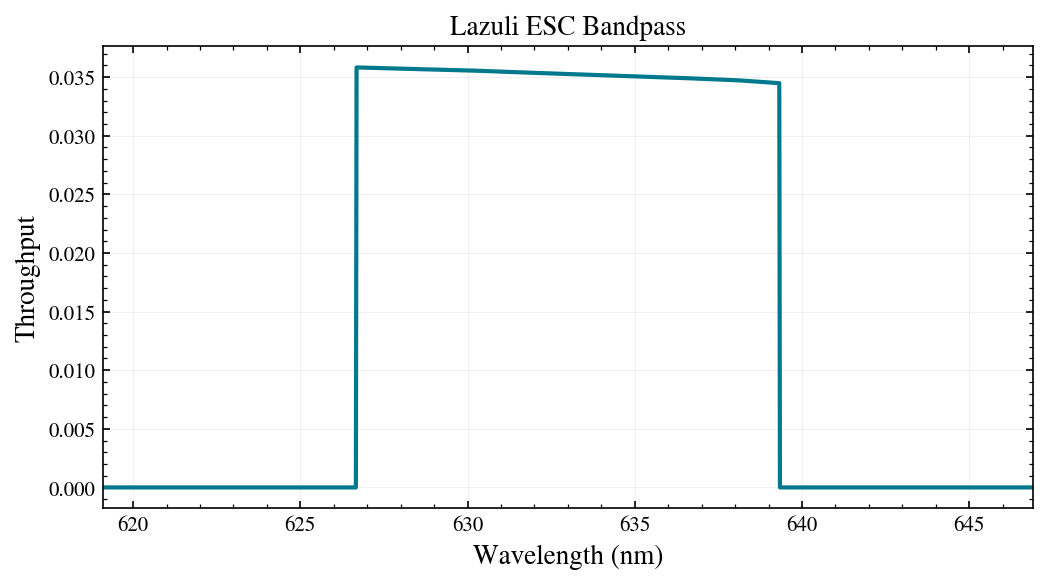
The two throughput terms behind an ESC result: the instrument bandpass applied to the source spectrum, and the coronagraph focal-plane-mask off-axis throughput applied to the planet at the requested separation.
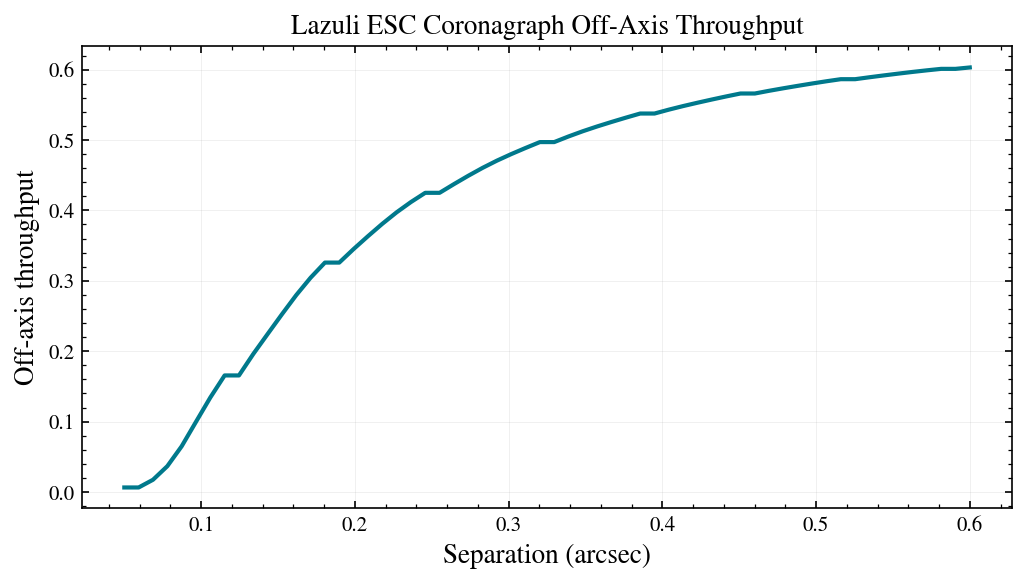
Currently modeled nominal ESC band, 627-639 nm, peaking at 3.6% total throughput. The full suite of ESC bands will be implemented soon.Throughput of the coronagraph focal-plane mask against separation. The steps are a sampling artifact: the curve is a FITS table sampled every 0.2 λ/D and the nearest tabulated point is used, so every separation inside one step returns the same value.
Off-axis throughput is read from a table sampled every 0.2 λ/D, about 11 mas at 633 nm, and the nearest tabulated point is used - separations within a step of each other return exactly the same throughput.
Throughput collapses inside about 0.1 arcsec (0.10 at 0.1 arcsec, 0.006 at 0.05 arcsec) and plateaus near 0.60 beyond ~0.5 arcsec. Treat results at very small separations as an inner-working-angle limit, not a sensitivity estimate.
The bandpass is fixed: there is no filter selection, and results cannot be extrapolated to another wavelength.
Site-wide notes
Scope and known limitations shared by all three calculators, the installed engine versions, and the link to the observatory documentation are on the site About page.